Know Your Rights: The stuff your boss doesn't want you to know

Regardless of work status (temporary or permanent, agency, full or part-time) or our contracts of employment, most of us have certain basic rights. These include:

1. The right to be told in writing how much and when we are to be paid.
The Minimum Wage for those over 22 years of age is set at £5.80,.  For 18-21 year olds it is £4.83 and for 16-17 year olds it is £3.57. For agency workers, wages must be paid on the agreed day, even if the hiring company has not paid the agency.

2. The right to at least 28 days paid leave per year.

Who are the Solidarity Federation?

Solidarity Federation (SF) believes in taking control of our lives where we live or work, rather than leaving things to the dictates of politicians, managers and so called ‘experts’. Through solidarity and acting together, we can deal both with our local problems and at the same time work to change the bigger picture, and change the system that means power and profit for the few.

Anarcho-syndicalism at work

There are political and economic assumptions in the way the existing, social democratic unions organise. They think workers and management have common interests, and that it is in their best interests to form partnerships. For example, to win the support of bosses in catering for the National Minimum Wage, in 1997 Labour allowed them to include workers’ tips in calculating it, in spite of the NMW being a key election manifesto point.

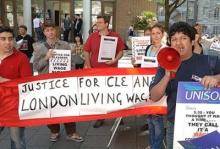
When equality means cuts

In 1997, councils across Britain came to an agreement with unions to undertake ‘Single Status’ job evaluations to end the discrepancies between manual and white collar jobs. Parallel to this, claims made about the historic pay discrepancies between traditionally male and traditionally female jobs were won at various Employment Tribunals. Historically, workers in female dominated jobs (such as those working around childcare) have been paid significantly less than those in jobs usually seen as ‘men’s work’, such as refuse collection.

Since the Equal Pay Act in 1970 these pay discrepancies had been open to legal challenge, but Single Status was supposed to be an across the board solution that would see every job within the councils evaluated and regarded equally based on the content of the job. In theory, this was of course a good thing.

Mail strike's roots in unfinished business

Workers at Royal Mail have voted overwhelmingly in favour of strike action over management plans for job cuts. 76% of workers who responded to the ballot voted in favour of industrial action. The roots of the dispute go back to the settlement that ended the 2007 national postal strike.

At the time it was announced as a victory, but in fact the CWU union agreed to management plans to cut jobs. The ‘victory’ was that the CWU and Royal Mail management would negotiate the details of the cuts at a local level. Now postal workers are unhappy with the results of those negotiations. One trigger is the Royal Mail’s refusal to “Pay for Change.” In unilaterally imposing such changes by so-called ‘executive action’, Royal Mail have reopened the dispute.

Freedom for the Belgrade 6!

Six anarchists from the ASI, Solidarity Federation’s Serbian sister organisation are currently imprisoned by the Serbian state.  Tadej Kurep, Ivan Vulovic, Sanja Dojkic, Ratibor Trivunac, Ivan Savic and Nikola Mitrovic are accused of  attacking the Greek embassy in Belgrade remain imprisoned, with (at time of press) no charges yet levelled at them.

The six have been targeted by authorities because of their politics and visibility, and face the ludicrous prospect of international terrorism charges - on the basis that as the embassy is sovereign territory, the attack had crossed an international border. The attack itself caused negligible damage, and has even been claimed by another group.  If international terrorism charges are brought, the Six face over 10 years in prison.

For Workers Control - Lessons of recent struggles in the UK

8-page leaflet looking at what we can learn from the 2007 postal strike, the 2008 public sector strike and the 2009 Visteon occupation.

The leaflet was produced for a demo against the Labour Party Conference on Sunday 27th September. It is based on several previously published articles and we try to draw the lessons of recent relevant struggles in the UK.

For Workers’ Control

Lessons of recent struggles in the UK

Recent years have seen promising signs of a working class fightback, after decades of attacks on working class living standards.

What is anarcho-syndicalism?

This is a leaflet we produced in August 2009, explaining some basics of anarcho-syndicalism.

If you want a copy, please get in touch with us, or download the attached pdf file.

What is anarcho-syndicalism?

Anarchism is a revolutionary political current that declares “freedom without socialism is privilege and injustice and socialism without freedom is slavery and brutality.”

Syndicalism is the workers’ movement. Deriving from the French word for Trade Unionism (Syndicalisme), it seeks to unite workers on an economic basis to fight for their interests.

Anarcho-syndicalism is anarchism applied to the workers’ movement. From small educational groups to mass revolutionary unions, libertarian organisation grows and is controlled from the bottom up.