Tube staff go off the rails
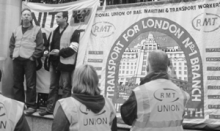
From 7pm on the evening of Tuesday June 9th until 7pm on Thursday June 11th 2009, London Underground workers in the Rail, Maritime and Transport (RMT) union took strike action. The main issue was job security as tube bosses flatly refused to rule out compulsory redundancies, putting 4,000 jobs at risk. London Underground originally also tried to force through a five-year pay agreement which could see significant pay cuts linked to deflation. This, alongside severe management bullying, led the workers to strike.
As the strike began, the London papers really pushed the boat out using distortions and outright lies to attack the striking workers. Claims of workers demanding 5% pay increases ignored the fact that management asked the RMT to submit a pay claim in November (when inflation was higher) while Transport for London have yet to offer anything. These sleight-of-hand tricks with the facts were coupled with barefaced lies like talks stalling over two sacked drivers on the Victoria line. This entirely separate issue, though symptomatic of wider abuses of procedure on the tube, were at no point a part of the main negotiations.
Of course, the papers also failed to mention the 123 tube managers on £100,000+ salaries, plus bonuses. Or that forty minutes before the strike, an agreement had been reached which, while the documents were being typed up, was cancelled by City Hall. These facts disappeared from media view entirely.
The theme of the media coverage was one of trying to stoke resentment against the strikers. Newspaper letters pages were filled with angry comments about ‘people losing their jobs while tube staff want more money’. We’re in recession now so we all have to tighten our belts, apparently. However, this just means that workers will be asked to tighten our belts, while our bosses continue living on six-figure salaries. Tightening our belts now doesn’t mean bosses will reward this good will in the future, rather they will see it as an opportunity for further attacks.
Rather than resent the tube workers’ struggle for jobs, conditions and pay, we should see it as a source for inspiration. As the recession continues, many of us will face similar attacks as bosses try to save money while saving their own salaries. Taking action together, like workers did on the Underground, will be the only way to protect ourselves from these attacks.
Victory at Linamar
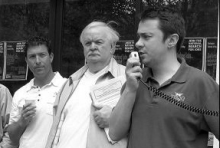
Rob Williams, Unite! convenor at Linamar’s Swansea plant, was reinstated on 11th June. An official indefinite strike was due to begin that day after a ballot resulting in 139 votes for and 19 against on an 88% turnout. Rob had been suspended on 28th April by car-part manufacturer Linamar, which had bought the former Visteon plant in July 2008, claiming an “irretrievable breakdown of trust”. This was met by an immediate walkout by the day shift; Rob locked himself in his office and workers surrounded it in an unsuccessful attempt to prevent his removal from the plant by the police. He was called in and sacked on 7th May.
This was clearly an attempt to break the union and force through attacks on pay, conditions and pensions by “buying down” – offering workers worse contracts in return for a one-off payment. The sacking immediately followed 140 voluntary redundancies and preceded pay negotiations where management were trying to get workers to turn down a Ford-linked 5.25% pay rise. Rob had also been prominent in organising support for the Ford Visteon workers who had occupied factories in Belfast and Enfield and were blockading Basildon.
This resistance doubtless both helped the Visteon workers win a partial victory in their occupation and galvanised Unite! which organised a ballot in record time, the result being announced on 28th May, to head off unofficial action. The fear of militancy in the car industry spreading would have been at forefront of both Linamar and Ford management’s and the Unite! bureaucracy’s thinking. It shows that rank and file militancy, direct action and solidarity work.
Demo in solidarity with cleaners
Members of North London SF demonstrated alongside other militants outside the head offices of London & Regional Properties, owners of Berns Salonger, a company that treats the cleaners it employs with intolerable conditions.
Fighting for the right to organise
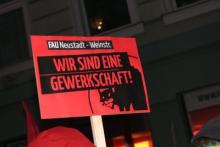
Across the world, other sections of the International Workers Association have been fighting state attempts to repress workers organisation.
In Serbia, in a dramatic turn, six Serbian activists, known as the Belgrade Six (for more details, see Catalyst #22 - available at http:// www.solfed.org.uk/docs/catalyst), were released on bail on the first day of their trial on February 17th.
Occupy and win!
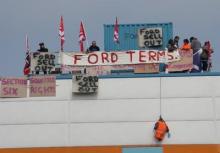
Workers at car parts manufacturer Visteon in Belfast, Enfield and Basildon occupied their factories on Wednesday 1st April, after they were given six minutes’ notice of closure and told to leave immediately. 565 jobs have been lost at Visteon plants across the UK. Left with no alternative, the workers staged a spontaneous sit-in, first in Belfast then spreading to the other two plants.
Sweep ISS out of SOAS
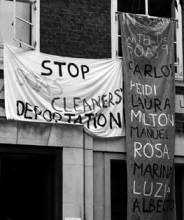
On June 12th, cleaners working for ISS at the School of Oriental & African Studies (SOAS) in London were called to a meeting by management. The cleaners were “processed” by immigration officials who detained nine of them as “illegal immigrants”. It was perhaps no coincidence that a picket of SOAS’ governing body demanding the reinstatement of victimised SOAS UNISON Branch Chair José Stalin Bermudez, who had been prominent in organising cleaners, had been called for that morning.
Those detained were denied union representation, but a campaign was quickly organised by SOAS campus unions and students, migrant worker activists and anti-deportation campaigners. SOAS management was held responsible for ISS “ambushing” their cleaners as punishment for winning union recognition and the London Living Wage.
Vote for change?
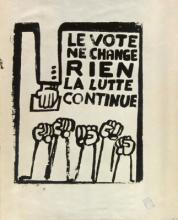
It’s election season again. It’s a time of photo-ops and promises, manifestos and controversies. But behind the endless announcements, allegations and denials, is anything really at stake? After 13 years of Labour government, many people want a change. The economy on which Gordon Brown staked his reputation as Chancellor has nosedived on his watch as Prime Minister.
China: trouble in the world's sweatshop
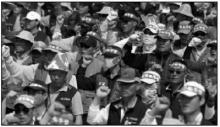
China is experiencing a rising wave of industrial unrest, as workers increasingly turn to collective action to fight against their exploitation.
Rapid industrialisation over the past few decades has created massive internal migration from the countryside to the cities on an unprecedented scale, dwarfing Britain’s industrial revolution two centuries ago. Now, this new urban working class has begun to flex its muscles, disrupting production in order to assert their demands.