The Social General Strike

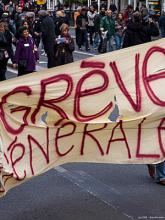
The idea of the revolutionary social general strike occupies a central place in anarcho-syndicalist theory. It marks the breach between those socialists who seek to capture the state - by revolutionary or democratic means - and those who see the need for the state to be shattered before libertarian communism can be achieved.

For anarcho-syndicalists it is the declaration of the independence of the labour movement, an independence that can only be brought about by the efforts of the working class itself.

Anarchism, Fascism & the State

This year marks the 75th anniversary of Hitler’s accession to power, it is appropriate therefore to look again at fascism, and to remind ourselves of those salient features of fascist movements and regimes which have become obscured with the passage of time. There is more to fascism than the legacy of war and genocide. That was where fascism ended, but during its rise, and where it took power in the years before the Second World War, many observers, particularly those on the left, noted its anti-working class bias and the nature of the economic system over which it presided.

Work, Buy, Consume, Die!: why capitalism needs the consumer dream and we don’t

    I asked the president, “What can we do to show support for America?” He said, “Mom, if you really want to help, buy, buy, buy”.

(Barbara Bush, 2001)

During the 1950s, at a time when the U.S. was in recession, Victor Lebow outlined what was to become one of the enduring tenets of global capitalism in the years to come:

    Our enormously productive economy demands we make consumption our way of life, that we convert buying and use of goods into rituals, that we seek our spiritual satisfaction, our ego satisfaction in consumption. We need things to be consumed, burned up, replaced and discarded at an ever accelerating rate.

No such thing as class?

After winning the 1959 election, Harold Macmillan, a Tory Prime Minister announced that "the class war is over" - and promptly formed a cabinet boasting four lords. Forty years later, Tony Blair, Labour Prime Minister, declared that "we are all middle class now" and politicians, academics and social commentators continue to tell us there is no longer such a thing as class in modern Britain. Notions of belonging to the working class are, we are told, outdated and belong to era of flat caps, factories, steel works and going down the pit. However no matter how many times we are told this we seem determined not to believe it. In a Guardian/ICM poll in October 2007 most British people still felt bound by class, with a massive majority - 89 per cent - of those surveyed feeling their social standing determined the way they are judged by the rest of society.

Battle to Save GP Surgeries

Sixty years after its birth, the process of auctioning off the most profitable sections of the NHS is now well and truly underway. GPs who have traditionally run their own small, locally-based surgeries are now being forced to compete with huge international companies as a result of legislative changes introduced in 2003.

Our Health, our Care, our Say? You must be Joking

You must be Joking: reports and comment from the health and social care frontline

Putting Profits First

In the last couple of years, the Government has announced far-reaching plans to radically transform the way in which social care is delivered to vulnerable members of our community. With the Our Health, Our Care, Our Say White Paper and “Putting People First”, plans to massively extend the use of individualised budgets and self-directed support schemes have been outlined.

So what does this mean in practice? And what are the implications for both service users and their carers?

Credit Crunches and Capitalist Calamities

Just when you think the credit crunch may be past the worse, along comes another bank, or two, or three, going bust and the financial system is thrown yet again into crisis. And as each crisis hits, governments rush in with our billions, to keep the whole financial sector from collapse.

So much for all that crap preached for years about the need for market discipline under which uneconomic companies are allowed to go to the wall. It would seem that the iron laws of the free market only apply to coal mines. The banks are allowed to play by another set of free market rules, in which the well connected are allowed to make billions from corrupt deals, then when it all starts to fall apart, we pay the price with rising unemployment, falling living standards and repossessions. In the words of the old song, it’s the rich who get the pleasure and the poor who get the blame.

Have your say: Union Busters

Dear DA,

There’s a new threat to workers organisation stalking the British labour relations scene. Employers are increasingly turning to U.S. style management consultants that “specialise in union avoidance and preventative industrial labour relations”. At least, that’s how the Burke Group describes itself. The Omega Division, an arm of Burke, was last year called in by Lion Capital, owner of Kettle Foods, in its attempt to prevent the T&G/ Unite from organising workers at its Norwich plant. The Burke Group has also been consulted by T-mobile and Virgin Atlantic.

Financial Crisis: What Happened? What Next?

Dear DA,

Even without really understanding the current “financial 9/11”, one can pick up a sense of fear, panic and uncertainty.

Blame for the crisis is attributed to “greed and fear”…or insufficient regulation…or too high bonuses paid to financial whizz kids…or irresponsible lenders pushing cheap loans…or irresponsible individuals accepting them…and so on.

But the crisis also needs a deeper structural analysis of how financial markets have changed over the past 2-3 decades – because it is these changes that lie behind the current financial meltdown, particularly those changes associated with “new financial instruments” and “vehicles” such as derivatives and private equity.